Eritrea
The Block
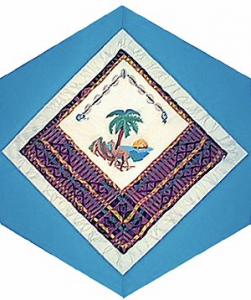
This block, designed and stitched by Mulugeta Negash Desta, features several elements of Eritrean culture, worked in a variety of techniques. It was inspired by ancient traditions and Mulugeta’s desire to teach others about his homeland. The central scene includes a beaded yellow sun, rising over the Red Sea––a sign of ‘good hope’ for Africa––an embroidered desert, colourful mountains and graceful palm trees, which signify the main topographical elements of the land.
The camel (Eritrea’s national emblem) represents the country’s still largely rural way of life. Camels are used for transportation and ploughing. As pack animals, their milk is a main source of nutrients and their hides are used to make leather goods.
Nine cowrie shells from the Red Sea represent the different ethnic groups that make up Eritrea’s population. They are anchored by tiny ‘man’ and ‘woman’ symbols that reflect the block-maker’s pride in the increasing equality of men and women in his native land. The scene is framed by a border of richly hued, woven fabric that was cut from the bottom of a woman’s traditional garment. The background of the block is made of fabric typically worn by Eritrean women on special occasions.
Cultural Profile
Formerly the northernmost province of Ethiopia, Eritrea is one of Africa’s youngest countries. It is an ancient land whose known history goes back thousands of years. The 1995 discovery of a human fossil in that country, estimated to be over one million years old, has led to speculation that Eritrea may be the cradle of our species. Its name is derived from the Greek word for red––erythrea––a reference to the Red Sea along which Eritrea’s coastline stretches for over 1,000 kilometres. The country is approximately the size of Nova Scotia and New Brunswick combined. Its terrain includes an area known as the Denakil Plains, which is home to the Denakil Depression, one of the hottest places on earth. Along with several other countries, Eritrea claims to be the site of the fabled ‘Land of Punt,’ a Horn of Africa region (rich in gold, frankincense, flora, fauna, ebony, and ivory) which Egyptian Pharaohs raved about in the year 2900 B.C. As a result of Italy occupying Eritrea’s territory in the first half of the 20th century, the capital, Asmara, is renowned for its well-preserved modernist architecture.
The population of Eritrea is ethnically divided into nine groups: Tigrinya (the largest group), Tigré, Kunama, Afar, Saho, Bilen, Nara, Rashaida, and Hedareb. Although the country has no official language, Tigrinya and Arabic are used officially in government. Other languages spoken include Tigrés, Afar, other indigenous tongues, as well as English and Arabic. Half of the population is Christian, while the other is Muslim, with small numbers still practicing ancient beliefs.
Eritreans have a strong sense of family unity, a sentiment often extended to strangers. Hospitality is very important, with the coffee ceremony being a staple of Eritrean life. During this ceremony, green coffee beans are roasted in front of visitors, ground and then brewed up to three times in the round jebena, a ceramic vessel, before being served to guest. During the coffee preparation incense is burnt. The elderly hold a special place in society where they are treated with great respect and frequently asked for advice. Eretrians also have a passion for learning and are known for putting their knowledge to practical use.
The Eritrean way of life encompasses a rhythm and pageantry that persists despite years of great adversity. Music is important and includes traditional instruments such as the krar (stringed instrument played like a guitar), abangala (a banjo-like instrument), the cira-wata (a single stringed instrument played with a bow), and kebero (drums).
Each ethnic group has its own special handcrafts, many of which, such as cotton shemma weaving, and knitwear, are recognized for their vibrant colours. Other traditional art forms include woodcarving, pottery, leather goods, and silver and gold jewellery. For women, the jewellery worn is an important part of the traditional dress of the various ethnic groups.
Eritreans have been coming to Canada since the 1970s for a variety of reasons. Many arrived as refugees fleeing their war-torn country, or as a result of famine caused by drought. Others came here to further their education or to look for work. As professionals and tradespeople, they tended to settle in the larger urban areas of Ontario, Québec, Manitoba and British Columbia where they were more likely to find employment. The Canadian census reports the presence of over 13,000 people from the independent state of Eritrea in this country.
Sponsor: Information Gateway Services (IGS)