
Oman
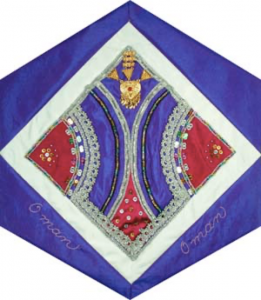
The Block
Elegant fabrics, donated by Christa Ohlmann, have been creatively arranged to form the Oman block. The brilliantly colourful pieces were taken from traditional Omani clothing and, as is often the case with garments from Oman, they have been hand-embellished with the sequins, silver lace and intricate embroidery typical of special-occasion attire. Along with the abaya, the heavy black robes common in much of the Gulf region, Omani women also clothe themselves in vibrant, colourful dresses that are wrapped with even brighter shawls and veils. Many women also wear a distinctive face mask, which, depending on the region, can announce the social status of the wearer. Men also enjoy richly coloured clothing and are often seen in bright blue, loose-fitting, floor-length shirt-dresses called dishdashas.
Cultural Profile
The Sultanate of Oman occupies the eastern corner of the Arabian Peninsula along the Gulf of Oman and the Arabian Sea. This small southwestern Asian nation is the second largest in the Arabian Peninsula and is bordered by the United Arab Emirates (UAE), Saudi Arabia, and Yemen. Musandam, Oman’s small exclave, is completely surrounded by the UAE and overlooks the Strait of Hormuz, between the Arabian Sea and the Persian Gulf, making it one of the most strategic places on Earth. Oman’s diverse geography includes a magnificently rugged coastline (1700 km long) as well as tranquil beaches, craggy mountains, salt flats, deserts, and valleys that spring to life during the monsoon season.
A once prosperous seafaring nation, with influence spreading as far as Zanzibar, Oman has experienced its share of strife through its 5,000 year old history. In the last thirty years however, it has been transformed into “a prosperous and stable modern state.” Omani Arabs, who make up 75% of the population, encompass many distinctive minority groups, such as the northern Shihuh, the southern Jibalis of Dhofar, and the Bedouins. Indians and Pakistanis make up most of the remaining population. The official language is Arabic, although English is widely spoken, as are Asian tongues, including Hindi, Urdu and Baluchi, and Swahili, due to the close link between the Swahili Coast and Oman in past centuries.
In spite of Oman’s rapid modernization, its way of life has stayed largely traditional. Some differences in basic aspects of daily life exist due to the diversity of its population, but the family remains the main social unit for society. A large portion of the population is involved in fishing and agriculture––Oman grows over 60 varieties of dates––although oil and gas reserves discovered in the 1960s have become vital commodities.
Omanis are known for traditional craftsmanship in such areas as shipbuilding and metalworking. The traditional dhows are still built in the city of Sur. Craftspeople produce fine silver jewelry, as well as silver-sheathed ornamental daggers called khanjars that hang at the waist of Omani men. Bedouin weaving, called sidu, is also done in Oman. Sheep or goat wool is used to make the traditional Bedouin tents essential to this nomadic people’s lifestyle. Frankincense has been produced in the country for generations; the oil and incense made from the rare frankincense trees of Dhofar was once more valuable than gold. Rose water, a staple of Middle Eastern and Persian cuisine, is distilled from roses grown in the Al Jabal Al Akhdar, the Green Mountains.
Persian and Indian influences can be seen in Oman’s conventional architecture and there is a strong history of literature and dance, although musical expression is limited as a result of religious interpretation.
People from Oman have made their home in Canada since the 1970s. Their numbers remain small, but they maintain a tight-knit community that is as vibrant as the colours of their clothing.
Sponsor: Melody Music Centre