
Dakota
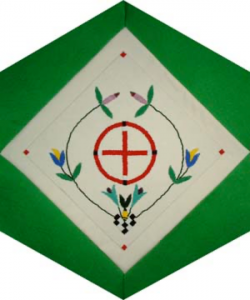
The Block
Wendy Whitecloud, a law professor at the University of Manitoba, produced the Dakota block from a design her good friend, Rainey Gaywish, created. Rainey, who also supplied the beads and materials for the piece, based the design on an historic Eastern Dakota (Sioux) pipe-bag pattern from the mid-1800s. It begins with a foundation in black and white beading that shows the duality of life for Dakota people; past and present, male and female. The mandala represents the circle of all life, the four directions of the universe, and the Dakota people’s belief that all animate or inanimate forms are their relatives. The stylized flowers, a traditional pattern that would have been created in quillwork before the availability of beads, are based on typical eastern Prairies flora.
Cultural Profile
The Dakota–at one time also known as the Santee Sioux–are, along with the Lakota and Nakota, a branch of the Sioux Nation. Dakota is a Sioux dialect and the names Dakota, Lakota and Nakota mean “those who consider themselves kindred.” Collectively, they were the Oyate, “the people.”
Oral histories retained by some of the elders provide a better understanding of the complexities of Oyate tribal and family relationships. Kinship is an important value in Dakota culture and the way by which Dakota understand their place of belonging as members of the Oyate. The immediate family is Tiwahe, the extended family is referred to as Tiospaye, and the band, a group of inter-connected extended families, is called Ospaye.
The Dakota Sioux were pushed onto the plain, into the area now known as Minnesota, from the woodlands east of the Missouri River. They adapted to a nomadic plains lifestyle that depended largely on the buffalo for everything from tipi covers to clothing, from tools and utensils made of bone to water bags made from buffalo bladder or stomach. The women would decorate their family’s clothing with a variety of different objects, including Buffalo teeth, which made wonderful tinkling sounds when attached to fringes. Porcupine quills were dyed and used to create beautiful and symbolic designs.
Quillwork was considered an art form requiring years of practice before one could be considered an expert. When European beads began to circulate amongst the people, they quickly mastered the art of beadwork and simple designs grew ever more complex. The designs are rich in meaning and often record family or personal histories.
As white settlers began to push further westward, the Dakota moved into the Dakota Territory. They originally crossed into Manitoba, Canada from the United States during the 1860s when their traditional way of life became threatened. In 1875 they were granted two reserve areas at Oak River and Birdtail Creek. Later, in 1886, a reserve area was surveyed at Turtle Mountain, but remained unconfirmed until 1913. Today, Dakota descendents live mostly on reserves in Manitoba and Saskatchewan. Many of the bands belong to the Dakota Ojibway Tribal Council.
Sponsor: Mr and Mrs Norman Rietze