
Samoa
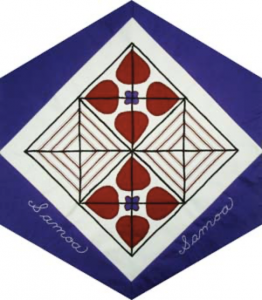
The Block
Among Samoa’s oldest cultural traditions is the making of siapo, a tapa-like fabric made exclusively from bark of the paper mulberry tree. The skills to create such cloth, which is used for both functional and ceremonial purposes, have been passed from generation to generation for centuries, but even so, this distinctive art form has become nearly extinct. This block, made by Elizabeth Ferguson, features a modern interpretation of siapo, represented in the customary colours of red, black and brown. The leaf motif, appliquéd against a cotton background, is one of the thirteen traditional design elements, which form the basis of all siapo and reflect the Samoan environment.
Cultural Profile
Samoa (formerly Western Samoa), a volcanic tropical land located in the south-central Pacific Ocean, is one of the smallest countries in the world. It is divided into nine islands, four of which are inhabited: Upolu, Savai’i, Apolima and Manomo. According to legend, Samoa is known as the ‘Cradle of Polynesia’ because Savai’i Island is thought to be Hawaiki, the Polynesian homeland. The population is comprised primarily of ethnic Samoans, as well as Euronesians (people of mixed European and Polynesian ancestry) and a small fraction of Europeans. The official language is Samoan, believed to be one of the oldest Polynesian tongues. English is widely spoken as a second language, a legacy of New Zealand’s rule over the country for a large part of the 20th century. Today, there are more Samoans living abroad than on the islands themselves.
Although some Samoan values and customs have changed because of European influences, Samoans have worked hard to preserve the fa’a Samoa (Samoan way of life), an all-encompassing concept that dictates how one should behave. The aiga (extended family) is extremely important, as is the idea of respect. The traditional Samoan house, the round fale, is an example of how communal life is led in Samoa. These houses, which have no walls, serve as living and sleeping spaces for extended family. Another important tradition in Samoa is the ‘ava ceremony, a highly ritualized ceremony during which the drink made from the ‘ava plant. It is drunk in wooden bowls dedicated to this sole purpose.
Music and dance have long been integral parts of Samoan life, and the country’s musical styles are renowned throughout the Pacific islands and the world. Fiafias, traditional Samoan meals accompanied by singing and dancing, are celebrated regularly. They include such song styles as pese, and dances. In the siva dance, performers wear a tuiga or headdress of feathers and human hair, stand and enact an everyday activity. For the sasa, a group dance, performers stand or sit and use hand movements to depict activities of daily life.
One of the most prized possessions of Samoans are the ‘ie toga, fine ‘mats’ woven by women from specially selected pandamus leaves and red feathers. Even though they are called mats, the ‘ie toga are never used as floor coverings. Instead, they are an important part of Samoan social life, used as gifts for important occasions, or worn by an important person for special events. The traditional dress of the Samoans is the lavalava, a wraparound cloth worn by both men and women.
Other significant art forms include tatau tattooing. One of the customary rites of passage for young boys is to visit a tufuga or tattoo artist, for tattooing from waist to knee. Girls are tattooed from below the knees to their upper thighs. Oral literature in which genealogies, legends, and chants are passed down through the generations are also important traditions in Samoan culture.
People coming to Canada from Samoa have been shown on immigration records since 1974, the year individual nations were listed as opposed to being included under regional designations. The number of Samoans in this country however, is very small; according to the 2011 census, there are less than one thousand of them living in Canada.
Canadian Slovak Butterflies 55+, Montréal